
Mayor William L. Strong
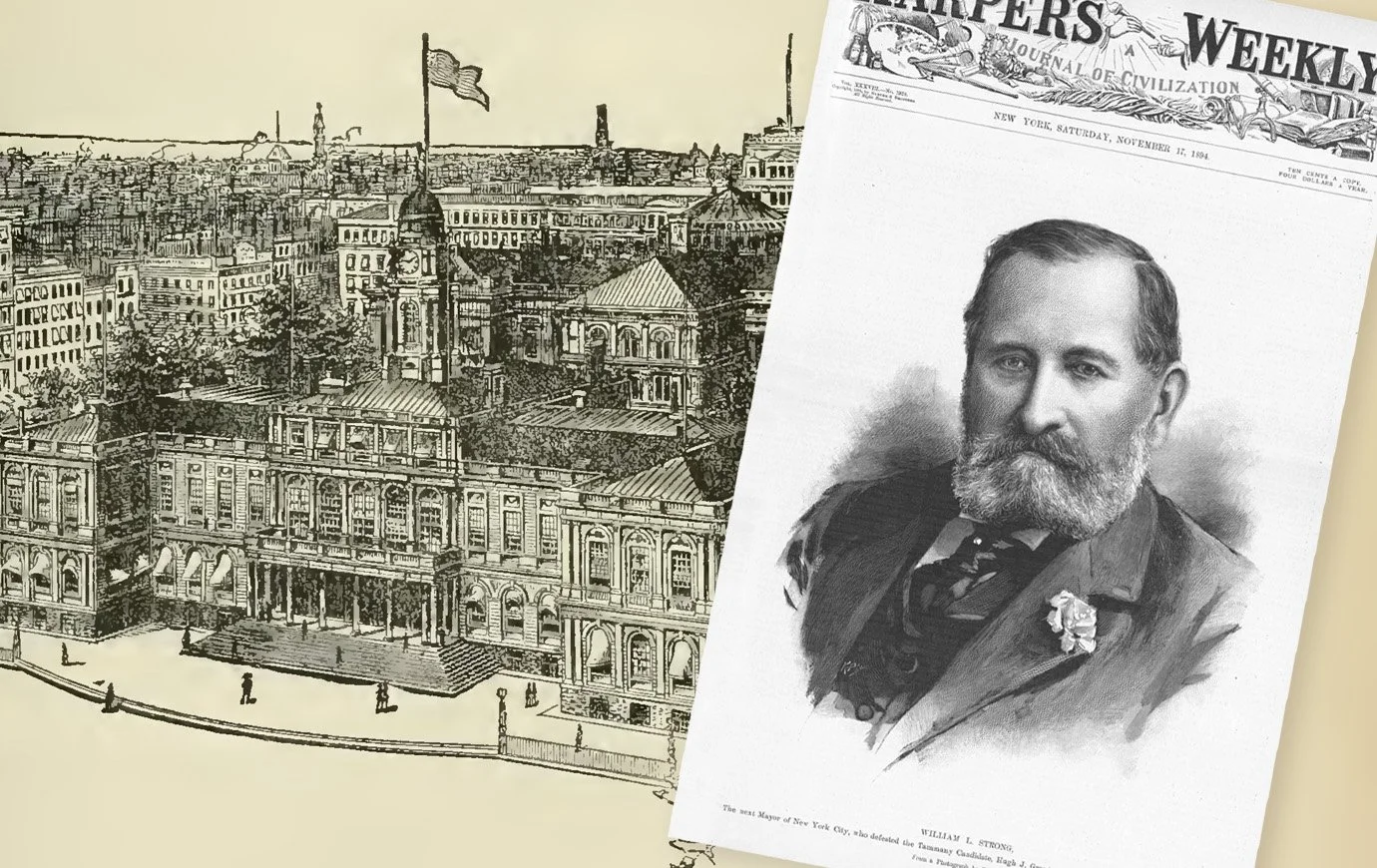
We have always been fortunate to have the support of New York City Mayors, and have seen 37 over the last 160 years. However, none have been more consequential for us than Mayor William L. Strong (1895-1897). Not only did he exert his influence to help the work of the Floating Hospital, but he also introduced us to the greatest benefactors in our long history.
He was from Richland County, Ohio, worked in dry goods, and continued in that line of business after moving to New York in 1853. By 1870 he was able to open his own dry goods store, W. L. Strong & Co. His success led him to become a director and then president of the Central National Bank. He was also a director of the New York Life Insurance Company, the Mercantile Trust Company, the Hanover Fire Insurance Company… the list goes on. “Colonel Strong has ever been an active factor in enterprises that have had some object of public benefit in view.” (1)
He was also one of our own… an early trustee of St. John’s Guild in 1876, and then again from 1889 to 1900. He took on the role of treasurer for five years, only stepping away while Mayor, and became Guild President after he left City Hall, from 1898 until his death in 1900.
When Leslie’s Weekly recommended him as a Mayoral candidate, they wrote “He has ever been the generous, unostentatious friend of the poor. In his devoted services and lavish gifts to St. John’s Guild in its noble work among the children of the poorest, Colonel Strong has earned the undying gratitude of tens of thousands of that unfortunate class,” adding “He can be elected if every voter who detests Tammany rule will take the pains to go to the polls and vote in his favor.” (2)
As Mayor, the reform-minded Strong established the New York City Board of Education, created small parks, and is credited as the “father” of the city’s Department of Corrections. “It was he who appointed Colonel Waring commissioner of street cleaning, resulting in the reorganization of the department and, for the first time in the history of the city, the actual cleaning of the streets. The reorganization of the police department he put in the hands of Theodore Roosevelt, who became president of the board.” (3)
His most impactful decision, from our perspective, was to appoint a fellow Ohioan (both men were trustees of the Central National Bank) Augustus Juilliard as one of his three Park Commissioners, a relationship that would carry significant weight later for the Guild. It was to the colonel that Helen Juilliard would write her letter, after he had left office, “promising to pay for a new boat for the use of St. John’s Guild,” adding “I authorize you to make the contract for said boat, and to draw on me for such amounts as you may require from time to time as payments become due to the amount of $32,000.” (4)
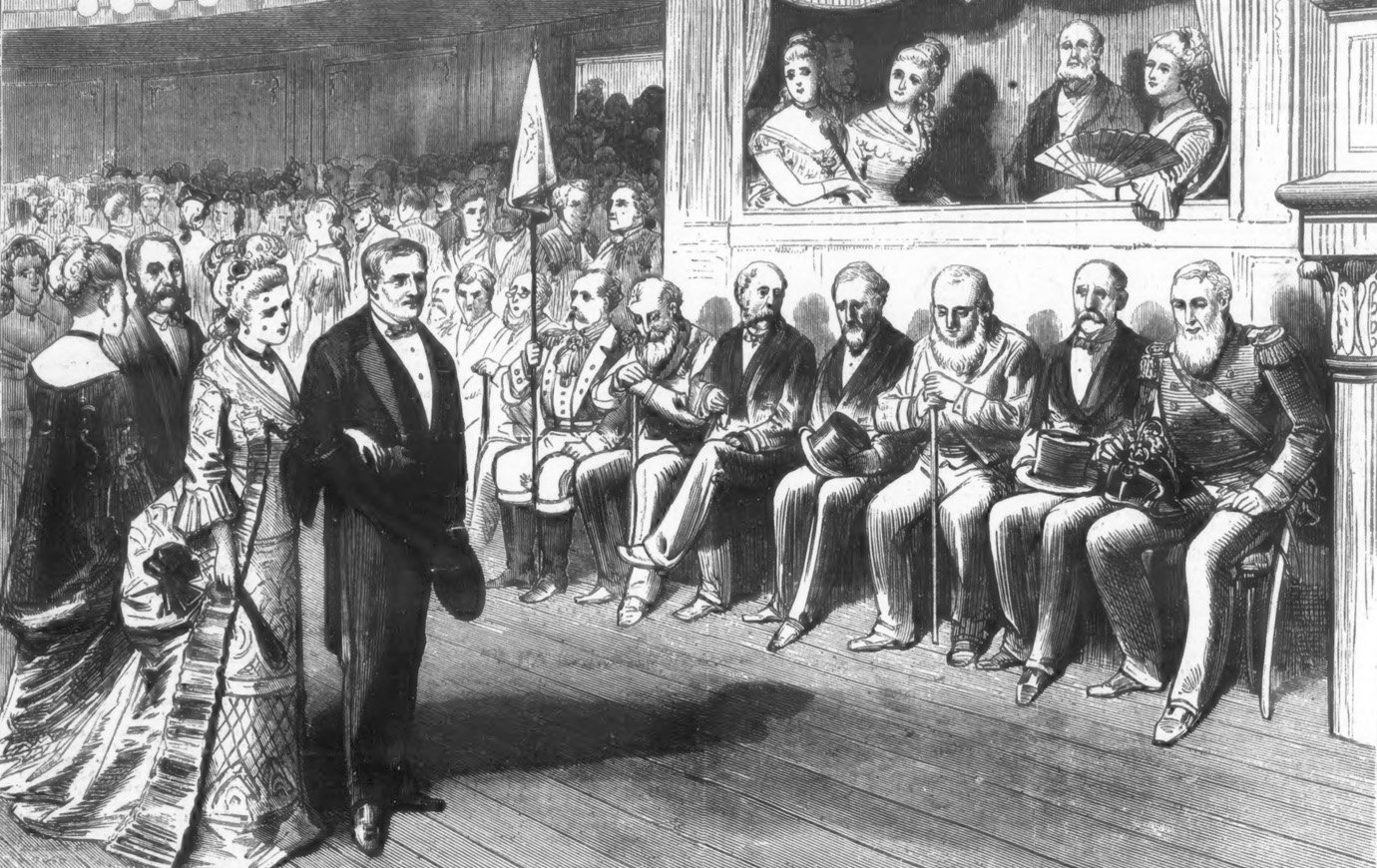
Governor Tilden and Mayor Wickham Opening The Promenade At The Martha Washington Reception, Frank Leslie’s Illustrated Newspaper, March 11, 1876.
City Hall connections
Mayor Strong was not our first connection with city hall, but part of a long line of mayoral support. There have been 37 over the last 160 years. John T. Hoffman (1866-1868) was mayor when we were founded, and Mayor William F. Havemeyer (1873-1874), our fourth, helped collect funds for our two trial excursions in 1873. Mayors William H. Wickham (1875-1876), Smith Ely Jr. (1877-1878) and William R. Grace (1881-1882) all attended our Martha Washington Receptions.
Seth Low (1902-1903), our 17th Mayor, contributed $250, the cost of a single trip, writing “I think of no work better worth during the hot weather… I wish that others who are able to do so would feel moved to provide for a similar excursion. I cannot believe that the generous people of New York would allow either of your floating hospitals [we had two boats then] to lose a single trip, if they could be made to appreciate the need and the opportunity.” (5)
Jumping forward, Mayor James J. Walker (1926-1932), opened Seaside Hospital for the season from his office in City Hall, using Televox, an early form of online switch control.
In more recent times, Mayor Abraham D. Beame (1974-1977) would launch the newly named Lila Acheson Wallace at the South Street Seaport, while David N. Dinkins (1990-1993), visited the boat multiple times, first as Manhattan Borough president and later as (our) 32nd Mayor, attending a fund-raising party onboard. When he first visited, he said “What a fabulous concept,” adding “It is a fascinating way to attract people to get preventative health care, which will allow them to live a more humane life.” (6)
Sources
“Republicans in Convention.” New York Tribune, October 6, 1894
“A Worthy Candidate.” Leslie’s Weekly 1894-10-25: Vol 79 Iss 2041
“Death of ex-Mayor Strong. End came suddenly just after midnight.” Boston Evening Transcript, November 2, 1900
A letter from Helen Juilliard. December 2, 1898. $32,000 is equivalent to $1.3 million today.
New York Tribune, July 31, 1903
Daily News, July 2, 1986