
Searching for the truth
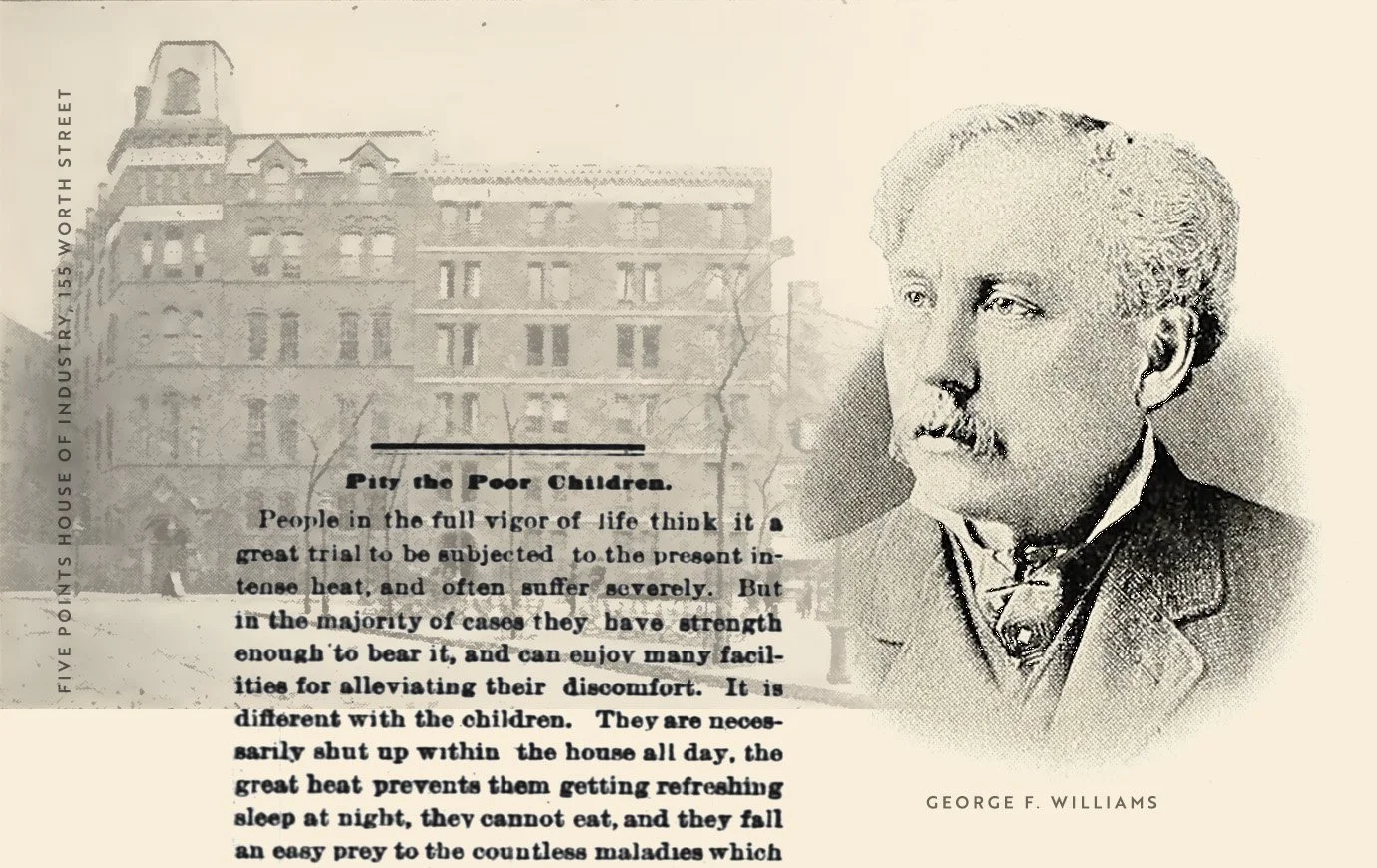
If you’ve been following along with the history of St. John’s Guild, you’re probably familiar with the iconic story of how The Floating Hospital came to be, of how it owes its existence to a chance walk across City Hall Park by a New York Times editor and the Children’s Excursion Fund that resulted.
As late as 2017, the Times itself would write of the Floating Hospital… “It traced its origins to 1866, with rented barges, and its getaway mission to 1872, when The New York Times reported on newsboys playing in a park and observed that they would do well to get some fresh-air relief from the crowded, fetid city that they plied every day.” (1)
It’s poetic, but that’s not what the Times reported on July 3, 1872 and the stories of what that writer saw appear to be largely shaped by individuals at St. John’s Guild many years later.
What we do know
George F. Williams, a colonel in the civil war and managing editor at the New York Times, was crossing City Hall Park on his way to the newspaper office in July on what would turn out to be the hottest day of the year in 1872.
John P. Faure, secretary of the Guild in 1896 said that Col. Williams “sent his wife and children to the country for the summer, and while crossing the City Hall Park he saw five little residents of lower New York seated under the shade of the nearest tree to the fountain on the easterly edge of the park, and heard the words ‘Let us play we were in the country.’” (2)
By 1916, the story had morphed. Duff G. Maynard, president of the Guild, said that Col. Williams “saw a number of barefoot newsboys and other little fellows playing on the grass and stopped to watch them. Just then a policeman came along and drove them off the grass onto the hot pavements. The little fellows limped and jumped on the asphalt, and one very little chap sat down and began to cry with the pain of the burns. Mr. Williams spoke to them, and found that they were suffering from lack of the country and right then he resolved that those boys should have a chance to run barefoot on the cool grass.” (3)
There is no record from Col. Williams himself. It’s probable he saw children as he crossed City Hall Park and they, just like thousands of poor children in the city at that time, were likely without shoes or hats and wearing threadbare clothes. But whether they were imaging the countryside or simply their next meal, we will never know. All we can be sure of is that he shared his concerns for their wellbeing with fellow editors, and an article, referencing neither hot pavements nor countryside, appeared the next day.
It was titled “Pity the Poor Children,” and quoted a doctor as saying “The children have been dying like sheep since last Thursday.” With reference to the intense heat, the writer added… “From our office windows we can see, any night, scores of poor little waifs and strays, lying about in City Hall Park, where, perhaps, they have been brought by some elder sister or kindly neighbor, in the hope of getting a breath of fresh air.” (4)
Thanks to the generous response of readers, excursions began just eight days later, taking out not newsboys but 500 children from the Five Points House of Industry and surrounding area. Almost immediately most major cities followed suit. First out was Philadelphia on July 30th with an excursion to Pennsgrove, NJ for 1,900 women and children. The Brooklyn Eagle, noting the success of the Times second excursion commented “As the bad things of New York are to be avoided, so the good things of New York are to be imitated, and this is one of them.” Brooklyn, still an independent city, created their own “Fresh Air Fund” and took 510 mothers and children via train to Canarsie for a picnic on August 1st. Boston, Albany and Baltimore were quick to follow.
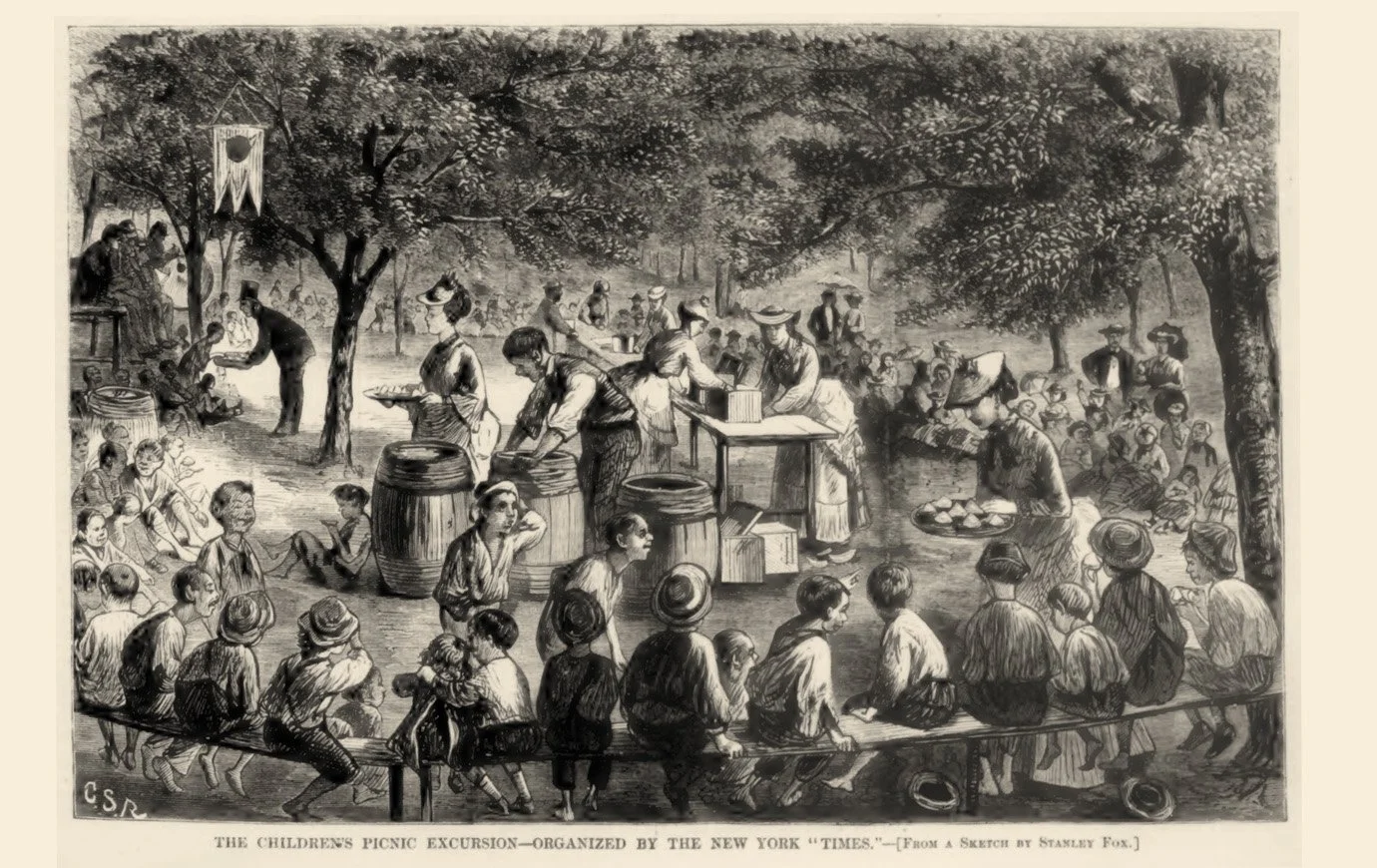
Harper’s Weekly, August 3, 1872
The Times excursions were so closely identified with Col. Williams, that despite a bitter break with the paper after the second season, he continued as superintendent, his “experience and past success are ample guarantee that the thousands of children who will come under his charge will be tenderly and strictly guarded.”
To the young children of the tenement districts, he “was instantly recognized and welcomed as if he was the long lost father of the entire family.”
Errors noted
There is also some confusion over what happened after the Times excursions ended. In 1916, Mr. Maynard was quoted in a Times article, stating “In 1873, finding that these excursions took too much of his time, Mr. Williams turned the charity over to the Guild, which began to carry them on after the same plan as before.” (3)
There are many errors within this statement, not least of which is the date.
There is no evidence of an actual request in the printed record, but it seems unlikely that Col. Williams would have reached out to the Guild, which was just one of the many groups taking poor children out on excursions. His connections with the Children’s Aid Society were extensive and more aligned with his original goal of helping poor, but healthy children. Certain members of that society, notably trustee and founder Theodore Roosevelt (Senior), accepted contributions, visited the picnic areas, and were generally suspicious of the Guild’s motives (Roosevelt would eventually have to recuse himself from an investigation a few year’s later due to his known bias, and the Guild was cleared of any wrongdoing).
Had the work of the Times and the Guild not overlapped for three years (ending in 1875), Col. William’s request might have sounded more plausible, but the timeline proved he was happy to continue the excursions for as long as funds were available. It was not unusual for Col. Williams to arrive ready to distribute tickets at a precinct house, and be greeted by screams of excitement from crowds of up to 3,000 poor children!
Over the course of four seasons, Col. Williams came to be “known probably by a larger number of the smaller population of New York than any other man who ever lived on the island,” wrote one admirer, who added he “originated a glorious idea and carried it with brilliant execution.” (5)
In raw numbers, the New York Times, across their four seasons, would provide respite to 75,147 children and organize fifty excursions. More importantly, they brought the fresh air idea, a concept conceived long before, into reality and inspired countless cities and organizations to respond to the suffering of their poorest populations.
Sources
“A Hospital No Longer Afloat, but Buoyant With Memories,” by James Barron, April 28, 2017
“Summer Care for Sick Children, by John P. Faure, Secretary of the Guild and Commissioner, Department of Public Charities.” The Independent, June 4, 1896.
“New Hospital Boat Goes Off the Ways. The Helen C. Juilliard launched for St. John’s Guild of New York at Wilmington. To continue old charity. Vessel, with room for 1200 mothers and children, to make trips by both day and night.” The New York Times, February 6, 1916
The New York Times, July 3, 1872.
“The Ragged Urchins’ Patron Saint, the Originator of the Poor Children’s Excursions.” The Star-Ledger, September 10, 1874