
Soup in Seven Languages
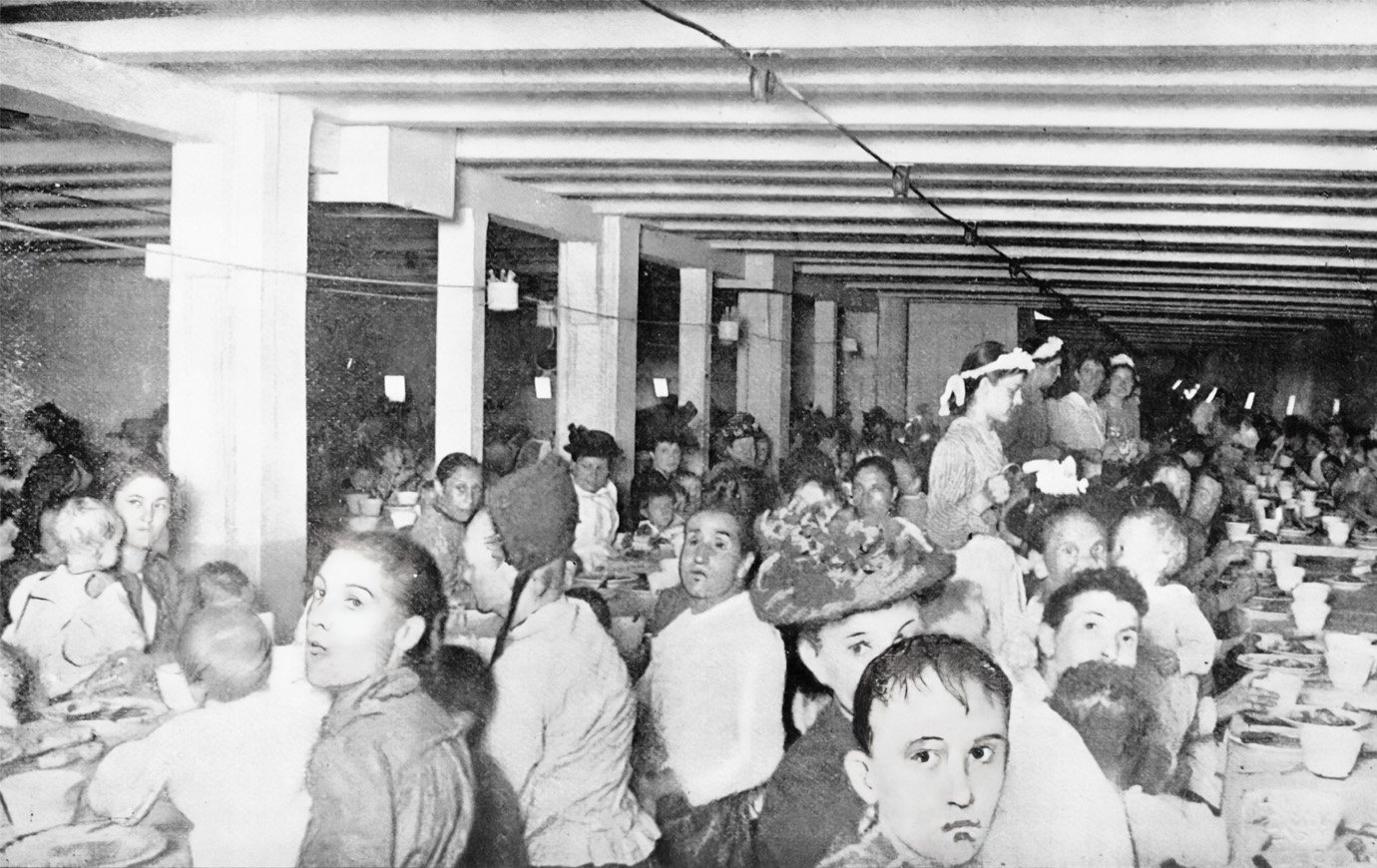
The dining room onboard the Floating Hospital was not an easy place to work in. Chaotic at all times, with 350 at each sitting, up to three (and sometimes four) times a day, with every dish washed and tables scrubbed in between, we were feeding people unaccustomed to even one full meal a week and keen to make the most of the opportunity.
The summer heat regularly killed over a thousand tenement infants each July due to improper nourishment, so the food, mostly Irish stew, rice or potatoes, tea or coffee, with babies getting milk or barley water, was as important as the medicine given above decks.
The first waitresses were volunteers, society ladies unused to waiting on the “rugged and uncouth in attire.” The hungry passengers, keenly aware of the class distinctions in front of them but caring little, were not shy in demanding more… “Gim’me s’more tomaties; ‘urry up now! I’ll give ye to know I’m aware o’ me rights here!” shouted one hungry mother. A reporter onboard noted the attendants… “sometimes lift their hands in horror and consternation at people with appetites.” (1)
Eventually the Guild hired staff to handle the load, but with the low pay, the employees “were of a class too nearly akin to the people they were set to serve to easily get long with them, and their negligent, unskillful performance coupled with their tendency to quarrel and exchange Billingsgate [coarsely abusive language] with the impatient and often unreasonable diners, made no end of trouble.”
By 1890 John P. Faure, (2) long-time Guild secretary, had seen enough, and invited an old friend, Mary J. Pierson, to take the newly-created position of Matron and help bring order to the chaos. She brought along a team she knew could be relied on, members of her own ‘Heart, Head and Hand Club,’ “A bevy of bright and pretty young girls in neat uniform of gingham dresses.” “Many of these young girls are type-writers or ordinarily are employed in dry goods and millinery shops, who prefer in the summer to take up this work both as a charitable mission and for the moderate pay it affords them. Their zeal, tact and willingness is of a quality that cannot be secured merely for wages, and it has happily solved the question of serving the peculiar and difficult class of guests who come aboard the boat.” (3)
For three years each summer, Pierson held the position of matron, but her usual role was as teacher at the Fifth Street Day School, “one of the most enthusiastic workers in the entire school department” and principal at the Houston Street Night School, a tireless advocate for her students… “all east side young women, workers in shops and stores and factories.” She implored them… “Some education is now needed by every girl to fill even the lowest position in life. How much more will be required to fill the higher positions that are every day being opened for women!” (The suffragist movement was gaining momentum at this time.) “Knowledge is power,” she emphasized. (4)
The H.H.H. club
Keen to continue improving the lives of those students when the night course was over, she organized them into ‘The Heart, Head and Hand Club.’” The object was “for study and self-improvement after they left school” and also “to do helpful work among the poor and sick of the city.”
One of the tasks they took on was to visit the rather grim Charity Hospital on Blackwell’s Island the second Sunday of each month. Faure donated money and accompanied the group, enlisting boys from the Knights of Temperance, and young men from the Society of St. Andrew, to help the H.H.H. women distribute hundreds of packages of tea and fruit, and they sang hymns to entertain the patients.
Describing Pierson’s role as the club “leader, advisor and friend,” the New York Sun wrote “Her ready sympathy, tact and direction keep keenly alive their interest in this work, and her encouragement gives unflagging zeal to their labors.” (5)
Sociological Laboratory
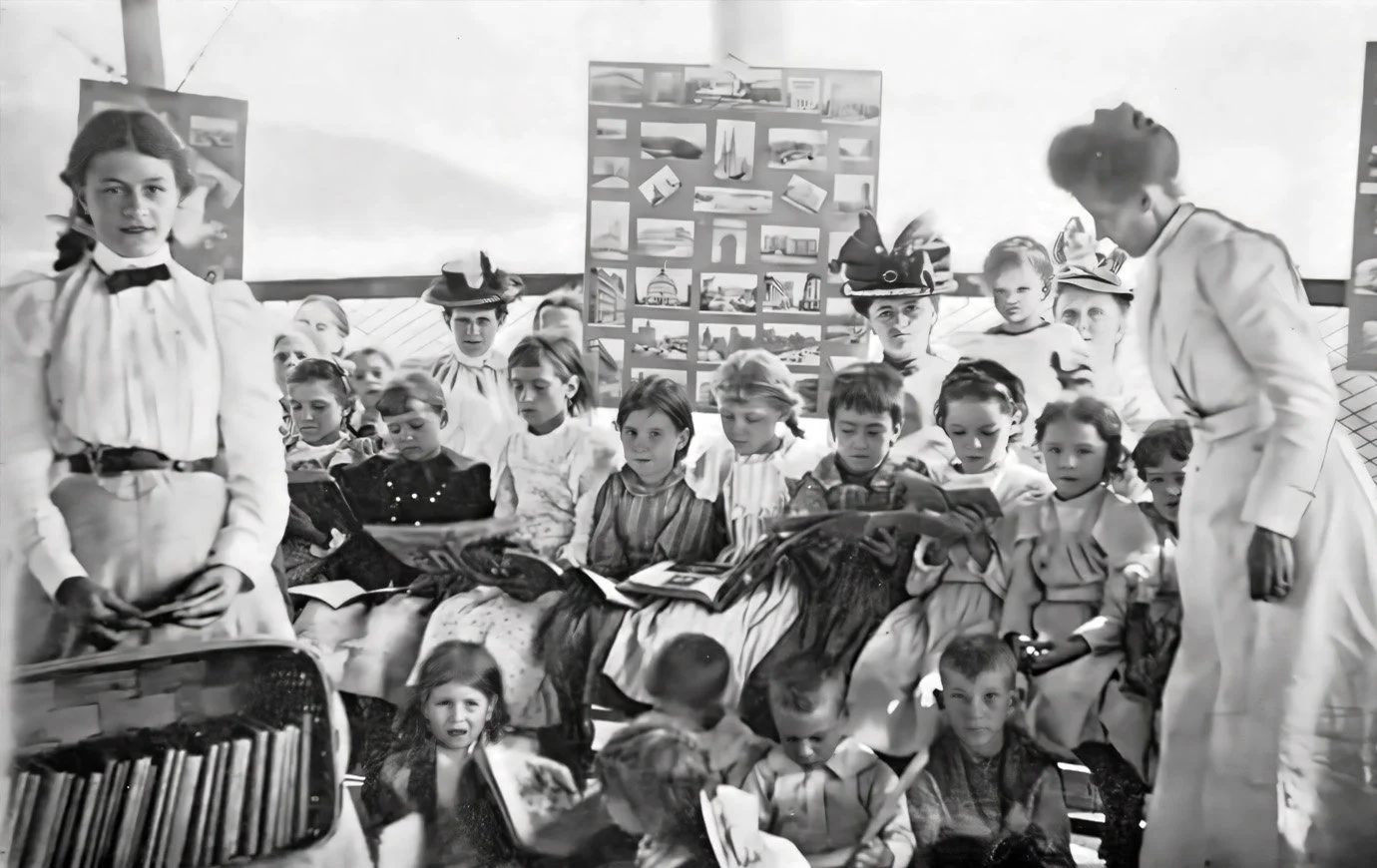
A few years later, having solved the dining room problem, Faure again persuaded Pierson (above, on right) to come onboard, this time to bring her teaching skills to establish a sociological laboratory—part library and part playroom—designed for observation and communication.
To help with her plan, she persuaded J. Norris Wing, of the New York Free Circulating Library to inspect the Emma Abbott and Helen C. Juilliard, knowing he would be receptive. The result was the allocation of a hundred books per boat, which became designated branches of the library, in addition to Seaside Hospital. “It gives the women a quiet time to read… it also gives the nurses a means of entering into conversation… sometimes this is a little difficult, but the book is an opening wedge, of which they are delighted to take advantage.” (6)
In addition to the library section, each space also contained a trunk filled with fifteen dolls and their clothes, pictures of old and modern New York, maps of the city, art and story pictures, kindergarten balls, rings and sticks, six dozen flags, colored beanbags, and sandbags.
A request had gone out in July for a dolls’ bedframe and furnishings, to be used in the kindergarten area: “If any [Tribune] sunshine girl who has grown beyond her doll playing age can respond to this call….” During playtime the dolls were dressed with nightclothes and placed in the bed with clean sheets as a way of teaching the children. (“People do not know of the little girls who jump into bed night after night wearing many of the clothes they have worn throughout the day.”)
The kindergarten balls and a prism were used to teach color theory, and color blindness was discussed. The flags were also popular, with the flag saluted, patriotic songs sung, and marches led around the boat. It was also noted that when the game of London Bridge was played, the children caught were given the choice of a dress or a doll and out of thirty, only seven took the doll. “The choosing of the dress was not considered childish vanity, but showed the children’s appreciation of their own needs.” (7)
The Story Behind the library
St. John’s Guild members were heavily involved in supporting the New York Free Circulating Library. In 1884, Oswald Ottendorfer, a former president of the Guild, offered a second location on Second Avenue with about 8,000 volumes. Mayor Strong, treasurer and later Guild president, was involved in fundraising efforts along with Andrew Carnegie, who was a life member of the Guild.
The idea came about when in 1879, “six girls belonging to a sewing class at New York City’s Grace Church were waiting for their teacher, and whiled away the time by listening to a sensational story read from a cheap paper by one of their number.” The activity had merit, but the tone and subject matter needed to be elevated. The resulting donations of books quickly grew to eleven locations around the city.
The nucleus of a traveling library system had existed almost from its beginning, providing to clubs, schools, or any responsible group of persons, books suitable for their needs, to be kept as long as needed.
Peace Initiative
In later years Pierson became active in the peace movement. After President Roosevelt won the 1906 Nobel Peace Prize for helping end the 1904–1905 Russo-Japanese war, many Americans wanted to avoid getting caught up in more (and more likely European) war. She attended the first New York National Congress initiated by the American Peace Society in 1907 under the presidency of Andrew Carnegie.
“Great interest had been aroused in an extra session, arranged largely through the initiative of Miss Mary J. Pierson, which filled Carnegie Hall from floor to ceiling with 4,000 young people who came as delegates from their schools, armed with pencils and notebooks to listen to the distinguished speakers.” One of the speakers was Baron Destournelles de Constant of the French Senate who declared it to be “one of the most inspiring occasions of his life, and added that the hope of the world for peace was in the unspoiled school children.” (8)
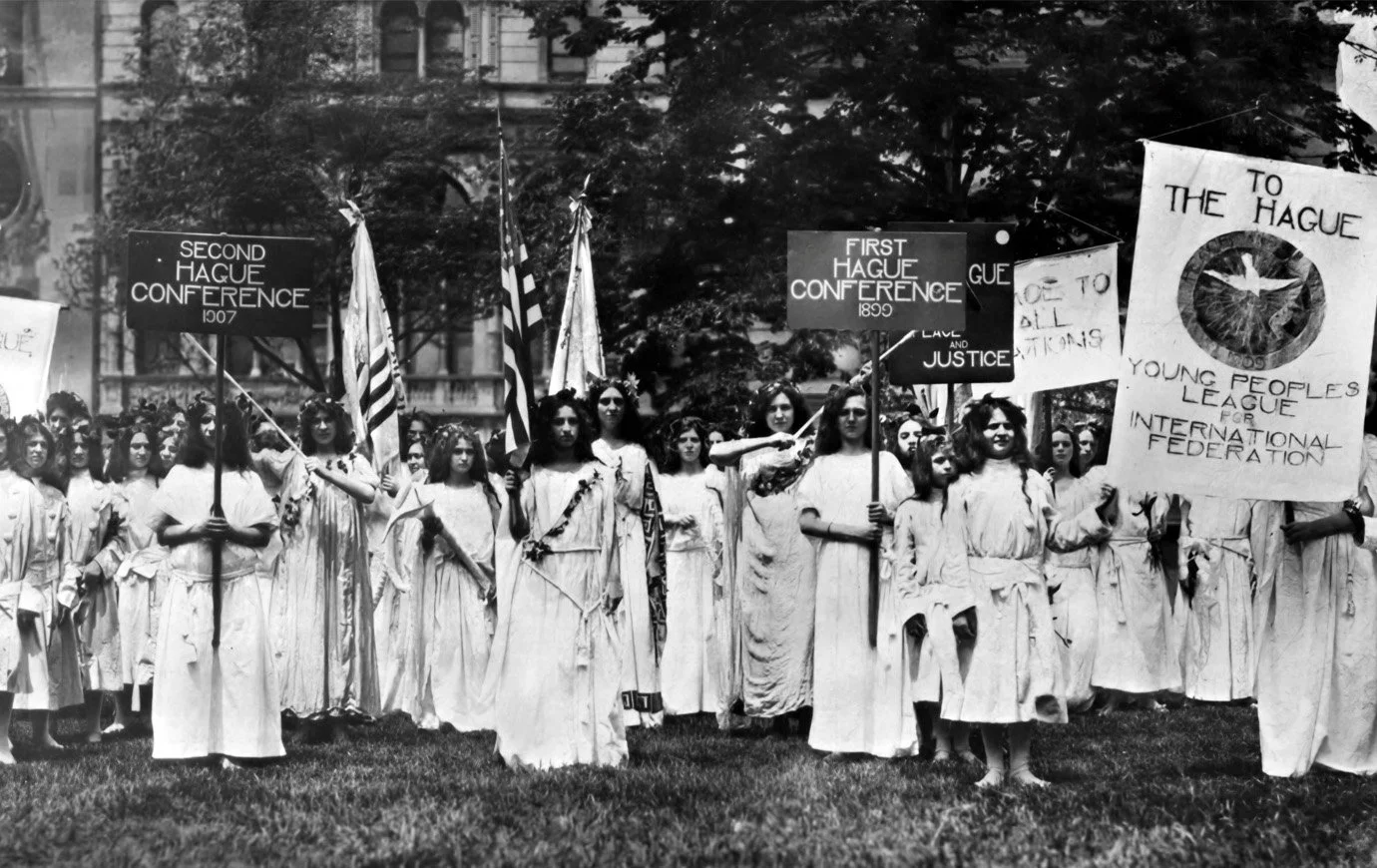
She saw teaching as the best way to promote pacifist thinking, founding the Young People’s League for International Federation, and gave speeches around the country.
A couple of years later, with Issac Seligman, Guild and parade committee treasurer, on the podium at the July 4th parade, her Young People’s League was represented by fifty girls garbed in classic Grecian robes of white. Some carried banners inscribed, “On to The Hague,” and “ Peace to All Nations.” Led by Pierson, they arranged themselves before the mayor and sang “Hail, Gentle Peace,” and afterward presented to the mayor a silken peace flag, the American colors on a field of white. “The children’s participation… made a deep impression on the thousands gathered in the square and adjoining streets.” (9)
The Actress and the Teacher
Pierson spent forty years in the public school system and was a member of staff at School 63 at First Avenue and Fourth Street when she passed away in 1921. In her final years, she had a friendship with a motion-picture actress, Marie Shotwell, who had heard Pierson giving a speech, some five or 12 years earlier (reports vary), and they had become unlikely friends (or so the story goes). This only came to light when the actress laid claim to the estate, valued at $25,000 (or up to $200,000—it varies widely by newspaper). Whatever the total, the deathbed will was contested and it was decided the teacher, suffering from cancer, “had been placed under the influence of a narcotic and was not in a mental condition to comprehend her act when she executed her will.” There was no next of kin, so the amount went to the state. (10)
We’ll never know why she didn’t leave a bequest to any or all of her favorite causes (the schools and the potential in her students; the ‘practical philanthropy’ at the Charity Hospital or on the Floating Hospital; her support of women’s education and work opportunities, or her fight for world peace in a fragile world). She at least lived long enough to see the passage of the 19th amendment and a woman’s right to vote, and while the Peace Movement proved ineffectual at preventing the Great War, she saw the work bear fruit in President Wilson’s League of Nations.
In a speech given in Chicago at the Second National Peace Congress, she said “We need joy in this world of ours, and there is joy in working for a great cause.” (11)
Sources:
The headline: “Saving Sick Babies — Soup in seven languages, and salt water in all the dialects of the earth and sea, are on these wonderful boats. So varied are the linguistic accomplishments of the help employed that no woman need stammer how the puny thing in her arms has suffered.” The Woman’s Journal: Boston, July 12, 1902
“The Babies Lifeboat. A sail up the Hudson yesterday—Seven hundred onboard—Good effects of a fresh breeze—The doctors applauding the work of the Guild—Alvah Wiswall’s philosophy.” New York Daily Herald, August 26, 1874
John P. Faure (1846-1912) — 1874: Secretary of the Sunday Schools Association; 1874: Trustee of St. John’s Guild (until 1903); 1876: Secretary of St. John’s Guild (until 1902); 1888: Trustee of the Common Schools of the Ninth Ward; 1894: Secretary of the Committee of Seventy; 1895: NYC Commissioner of Charities (appointed by Mayor William L. Strong); 1898: Worked with Red Cross during the Spanish-American War. His residence, at 238 West 11th Street still stands.
“Among Glad Sea Breezes. St. John’s Guild bears drooping babes from tenements.” New York Sun, August 7, 1892
“For East Side Night Pupils. The plans for the Houston street female senior school.” New York Sun, September 29, 1890
“What the ‘H.H.H.’ Club Does. East side work girls who visit Blackwell’s Island.” New York Sun, December 16, 1889
“Work of St. John’s Guild. New department for children established on hospital boats. The good results obtained. Work carried on is educational and methods of practical demonstration are employed—free library a feature.” The New York Times, August 27, 1899”
Report of St. John’s Guild, 1899
“Internationalism and Patriotism. The American School Peace League.” by Lucia mes Mead. Journal of Education, 1910-01-27: Vol 71 Iss 4
“The Peace Movement of America” by Julius Moritzen, 1912
“Actress to Lose Legacy Bequeathed by Teacher. Appellate Division holds Miss M.J. Pierson was of unsound mind when making will.” New York Tribune, December 23, 1921
“The Young Peoples International Federation League,” by Mary J. Pierson. Proceedings of the Second National Peace Congress, Chicago, May 2 to 5, 1909