
A connection to President Lincoln
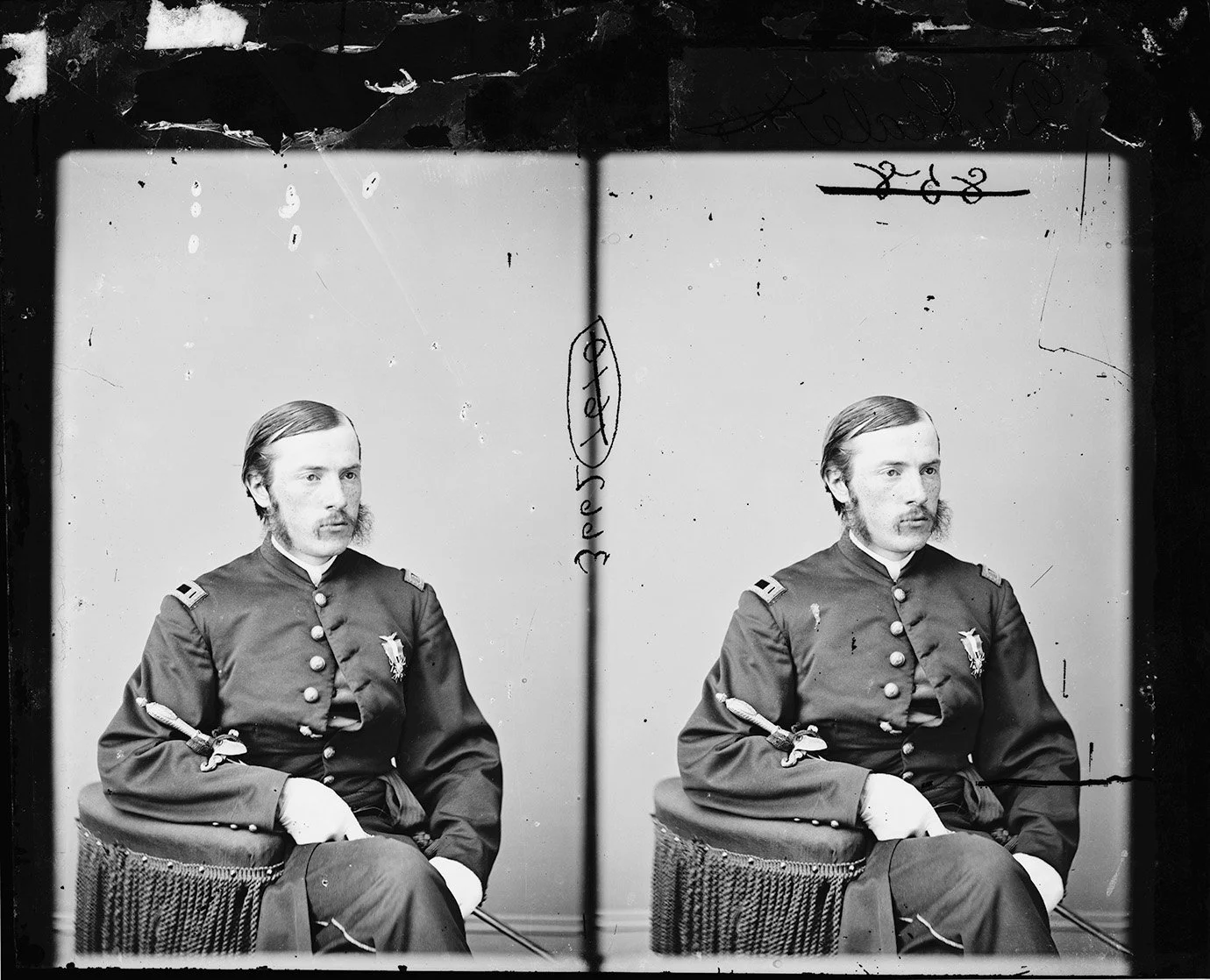
Dr. Charles A. Leale (in U.S. Army uniform) attended Lincoln at death. Glass negatives—1860-1870. Library of Congress.
Back in the early ’80s—the 1880s that is—one of our doctors would have been a celebrity to everyone who came aboard The Floating Hospital. To the Evening World, he was “one of the Guild’s most earnest workers.” But that wasn’t why he was famous. The paper also reminded its readers that “He was the first doctor to reach Lincoln’s side after Booth’s bullet struck him.” (1)
Dr. Charles Leale, only 23, was Surgeon-in-Charge of the Wounded Commissioned Officers at Armory Square General Hospital. As it was a slow night that April 11, 1865, he was able to slip away to Ford’s Theatre, knowing that the President was expected there.
After the President was shot, Leale, sitting in the Dress Circle seats close by, rushed into the box. There were other doctors in the audience that night, but he was the first to reach Lincoln. By medical protocol, that made Lincoln his patient until more senior physicians took over. Leale and the other doctors had Lincoln moved across the street for treatment, and was still present April 15 when the President died.
Four days later, Leale was one of the Honor Guards in the East Room of the White House, standing solemnly at the head of Lincoln’s coffin. Later, a long line of escorts formed along Pennsylvania Avenue to accompany Lincoln’s casket to the Capitol to lay in state. Leale and the other physicians during Lincoln’s last hours rode in a carriage in the place of honor in front of the funeral car. At some point in the procession, “an officer of high rank” leaned into Leale’s carriage and told him “Dr. Leale, I would rather have done what you did to prolong the life of the President than to have accomplished my duties during the entire war.” (2)
After Lincoln’s assassination, he kept himself very busy, focusing on the needs of the poor and children in particular. From 1866 to 1871, he was physician in charge of the children’s class at the Northwestern Dispensary, and for two years treated diseases of the heart and lungs at the Central Dispensary, both in New York city.
He became president of the Northwestern Medical and Surgical Society in 1872; of the Bellevue Hospital Medical College in 1875, and of the New York County Medical Association for two terms in 1885 and 1886.
The doctor had a long history with us, beginning as a Trustee in 1883. It was in that role in 1886 that he stepped in to help when the city ran out of funds to support their summer corp of physicians. The Board of Health distributed roughly half of the tickets for The Floating Hospital, so he and two other board members, along with six multilingual physicians, gave up their summer vacations and canvassed the city tenements. There, they discovered 3,376 sick children and made sure they benefited from the services onboard the Floating Hospital and at Seaside Nursery.
“The medical care and nursing that these helpless infants received need no further commendation, than the statement that they came from the most unhealthful homes, where poverty and vice frequently prevailed, and they were often far advanced in disease, yet only four were lost by death during the entire summer. Where can a better record be found, even in the case of a corresponding number of well children, among the most prosperous?”
Three years later he was able to reorganize the nursery and help convert it into one of the largest seaside hospitals for children in the world. He was elected Vice-President of St. John’s Guild in 1889-91 and President in 1892-93.
As if all that wasn’t enough, he was one of the founders of the Guild’s Children’s Free City Hospital, and was its consulting surgeon. (3) For those unaware, we opened our first year-round facility in 1892 in first one, then two adjoining brownstones on the upper west side. It became apparent very quickly that the buildings were not suitable and though the Guild tried earnestly to raise enough funds for a purpose-built building, they were unsuccessful and were forced to close the hospital in 1898. This would also be the doctor’s last year as a trustee.
According to Wikipedia, “Until his retirement in 1928, Dr. Leale maintained a continuous interest in philanthropic, medical, and scientific projects.
He was one of the last surviving attendees of Lincoln’s assassination upon his death in 1932 at the age of 90. The cuff of the shirt that Leale wore the night of the assassination, stained with Lincoln’s blood, was later donated by his granddaughter to the National Museum of American History.” (4)
Explore our Instagram archive page for more fascinating stories and images.
—
Sources
“Salt Air for Children,” The Evening World, July 24, 1888
“Physicians and surgeons of America [microform]: a collection of biographical sketches of the regular medical profession” by Irving A. Watson, 1896